Bacillus Thuringiensis | Trabe
Trabe Bacillus Thuringiensis – Selective Biological Control of Caterpillars
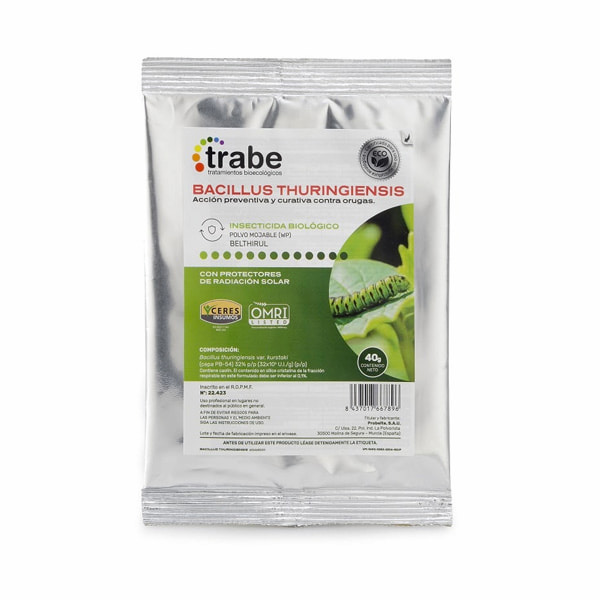
Trabe Bacillus Thuringiensis is a microbiological bioinsecticide designed specifically for the control of caterpillars and other lepidopteran larvae. Its active microorganism is Bacillus thuringiensis var. kurstaki, strain PB-54, supplied as a 32% wettable powder for foliar application.
Unlike broad-spectrum insecticides, Trabe Bacillus Thuringiensis targets a much narrower group of pests. This makes it particularly useful when caterpillars are the problem and you want a selective treatment that can be integrated into a wider biological pest-management programme.
When Does Trabe Bacillus Thuringiensis Make Sense?
Trabe Bacillus Thuringiensis is intended for infestations of lepidopteran larvae: the caterpillar stage of moths and butterflies. These larvae can rapidly damage leaves, shoots, flowers and fruits while feeding.
The treatment is most effective when applied while the larvae are still young and actively feeding. Waiting until caterpillars are large and damage is already extensive can reduce the practical effectiveness of a Bacillus thuringiensis treatment.
How Trabe Bacillus Thuringiensis Works
The PB-54 strain of Bacillus thuringiensis var. kurstaki produces insecticidal proteins during fermentation. Caterpillars must ingest treated plant material for these proteins to become active inside their digestive system.
After ingesting a sufficient dose, susceptible larvae stop feeding and subsequently die. This ingestion-based mechanism is why thorough coverage of the foliage is important and why Trabe Bacillus Thuringiensis works best while larvae are actively feeding.
How to Use Trabe Bacillus Thuringiensis for Best Results
Dissolve 1–2 g of Trabe Bacillus Thuringiensis per litre of water and apply as a foliar spray, covering the vegetation evenly so that feeding larvae encounter treated surfaces.
For Bacillus thuringiensis PB-54 formulations, treatment is generally most effective during the early larval stages. Technical guidance for this active ingredient also recommends using treatment water below pH 8, as strongly alkaline conditions can reduce the viability and effectiveness of the biological formulation.
Avoid combining the prepared spray with strongly alkaline products unless compatibility has been specifically confirmed. Prepare only the amount required for the treatment rather than storing diluted solution for extended periods.
What Makes Trabe Bacillus Thuringiensis Stand Out
Trabe Bacillus Thuringiensis provides highly targeted biological control rather than general-purpose insecticidal action. Its PB-54 strain acts specifically on susceptible lepidopteran larvae after ingestion, making it particularly suitable for integrated pest-management programmes where selectivity is important.
Technical Specifications
- Brand: Trabe
- Product category: Microbiological bioinsecticide
- Active organism: Bacillus thuringiensis var. kurstaki
- Strain: PB-54
- Concentration: 32% w/w
- Formulation: Wettable powder (WP)
- Main targets: Caterpillars and larvae of Lepidoptera
- Mode of action: Primarily by ingestion
- IRAC group: 11A
- Application: Foliar spray
- Dosage: 1–2 g/L
- Best timing: Early larval stages
- Treatment-water guidance: Preferably below pH 8
- Compatibility: Avoid strongly alkaline mixtures unless compatibility is confirmed
Frequently Asked Questions
What pests does Trabe Bacillus Thuringiensis control?
It is designed specifically for caterpillars and other larval stages of lepidopteran insects such as moths and butterflies.
How does Trabe Bacillus Thuringiensis kill caterpillars?
The larvae ingest Bacillus thuringiensis proteins while feeding on treated foliage. Susceptible larvae then stop feeding and subsequently die.
When should Trabe Bacillus Thuringiensis be applied?
Apply it when caterpillars are still in their early larval stages and actively feeding, as this is when Bacillus thuringiensis treatments are generally most effective.
How much Trabe Bacillus Thuringiensis should I use?
Use 1–2 g per litre of water and apply thoroughly as a foliar spray.


Please let me know when the product is available again:

Please let me know when the product is available again: