BackVertical cannabis cultivation: How to optimize your space with a multi-tier grow system
05.12.2025

- What Is Vertical Cannabis Farming?
- Advantages of Vertical Cannabis Farming
- Key Components of a Vertical Grow Setup
- Best Practices for Multi-Layer Cannabis Growing
- Challenges & Pitfalls in Vertical Growing
- Who Benefits From Vertical Cannabis Farming?
- HowTo – Vertical Homegrow Setup Step-by-Step
- Conclusion: Vertical Cannabis Farming for Homegrowers
- FAQ – Vertical Cannabis Farming
Vertical cannabis farming is one of the most exciting innovations in modern indoor cultivation. For homegrowers working with limited space, a cannabis vertical grow system or vertical grow setup can dramatically improve efficiency and production — provided it is properly designed and executed.
In this guide, you will learn what vertical cannabis farming actually means, how a multi-layer cannabis grow system works, what equipment it requires, and how to design a safe, efficient system to maximize grow space. We also highlight compact strains that thrive inside indoor cannabis vertical racks and multi-tier grow rooms.
If you are just starting out and would prefer to begin with a classic, level grow, we recommend that you first read our Indoor Grow Guide.
What Is Vertical Cannabis Farming?
Traditional indoor growing uses a single layer: one lamp above, plants below. With cannabis vertical cultivation, the grow expands upward. Instead of one layer, you stack multiple levels and use the entire room height. This transforms one square meter of floor space into two or even three square meters of productive canopy.
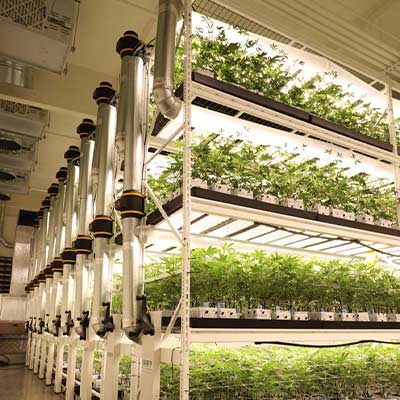
This is vertical cultivation. There are several ways to do it. In this mass production setup, you can see multiple vertical shelving units.
Basic Principles of a Multi-Layer Cannabis Grow System
A multi-layer cannabis grow system typically uses one of two structures:
- Vertical shelving or indoor cannabis vertical racks: metal racks or professional grow structures designed for multiple tiers of plants. Every layer has its own LED lighting, irrigation, and airflow.
- Cylindrical / tower systems: plants grow along the vertical walls of a cylinder while LED bars illuminate from the center.
In both models, the primary objective is to maximize grow space by multiplying canopy area within the same floor footprint.
How Vertical Growing Differs From Traditional Indoor Cultivation
Compared to a classic single-layer setup, vertical cannabis farming allows:
- far more plants per square meter of floor area,
- more efficient distribution of LED grow lights vertical systems,
- more complex airflow management (warm air rises into upper tiers),
- higher demands on irrigation, safety, and system organization.
Vertical systems often combine well with hydroponic vertical cannabis methods or even a specialized aeroponic vertical system to maintain consistent root-zone conditions across multiple layers.
Advantages of Vertical Cannabis Farming
Why are more growers switching to vertical cannabis farming? In dense cities or small apartments, space is extremely limited. A well-designed vertical grow setup allows you to maximize grow space without increasing your cultivation footprint.
1. Maximum Space Efficiency & Increased Yield per Square Meter
The most obvious advantage of a cannabis vertical grow system is far better space utilization. In small rooms, closets, or attics, growers can:
- double or triple their usable canopy,
- fit more plants into the same floor area,
- boost indoor yield optimization without expanding the room.
You’re not only adding more plants — you’re increasing the efficiency of the entire system. With proper lighting, airflow, and nutrient management, you can significantly boost your grams-per-watt and total yearly harvests.
2. LED Technology Makes Vertical Farming Possible
Vertical cannabis farming would be nearly impossible with old HID or HPS lamps — they produce too much heat and require too much overhead space. Modern LED grow lights vertical systems make vertical cultivation feasible thanks to:
- high efficiency with reduced energy consumption,
- customizable spectrum to match veg and bloom phases,
- minimal heat output, essential for multi-layer setups,
- slim bar-shaped LEDs ideal for mounting onto vertical racks.
These features allow consistent climate control inside any vertical cannabis farming environment and dramatically reduce cooling costs.
3. Improved Workflow & Grow Room Optimization
Setting up a multi-layer cannabis grow system forces growers to think more intentionally about grow room optimization. The result is usually a cleaner, more professional grow environment:
- clear airflow pathways,
- organized cable management,
- defined irrigation routes,
- structured routine for plant inspection and care.
Many growers find that once their system is arranged vertically, their workflow becomes smoother and more efficient — even if they eventually return to a single-layer style.
4. Indoor Cannabis Vertical Racks Provide Flexibility
One of the major benefits of indoor cannabis vertical racks is the flexibility to adjust your system over time. High-quality vertical racks offer:
- adjustable tier height,
- custom mounting options for irrigation lines, fans, and LED bars,
- modular expansion if you want to scale up later.
This makes vertical growing an excellent option for homegrowers who want to improve yield gradually rather than investing in a full-scale commercial system upfront.
Key Components of a Vertical Grow Setup
Before planning your vertical grow setup, it helps to understand the essential building blocks. Many elements match traditional indoor grows, but they must be arranged differently in a multi-layer cannabis grow system.
1. Racks, Shelving Units, and Grow Tents
A cannabis vertical grow system depends on strong, reliable racks. These can be industrial metal shelves, specialized vertical grow racks or just a modified growing tent built specifically for vertical racks for cannabis. Important factors:
- Weight capacity: pots, water, substrate, and equipment add significant load.
- Material: metal racks resist moisture far better than wood.
- Dimensions: choose depth and width that allow easy access for plant training and inspections.
- Access: you must reach every plant — even those on the back rows or upper tiers.
Some small-scale growers use modified warehouse-style shelving inside grow tents to create a low-cost entry into vertical cannabis farming.
2. LED Grow Lights for Vertical Cannabis Farming
In a vertical grow setup, one large lamp isn’t enough. Instead, multiple slim LED bars provide uniform coverage. When selecting LEDs, consider:
- Shape: slim LED bars fit perfectly across multi-layer racks,
- Coverage: even PPFD across each tier is essential,
- Heat management: reduced heat allows closer plant-to-light distances.
Look for features such as adjustable wattage, full-spectrum output, and high efficiency (μmol/J). These characteristics are vital for indoor yield optimization within a cannabis vertical cultivation environment.
3. Irrigation: Soil, Coco, Hydroponics, or Aeroponics?
Vertical cannabis farming works with any substrate, but some systems scale better:
- Drip irrigation — great for soil or coco, easy to manage.
- Hydroponic vertical cannabis setups — NFT or DWC systems maximize root-space efficiency.
- Aeroponic vertical system — provides exceptional oxygenation for advanced growers.
Key requirements for irrigation in a multi-layer cannabis grow system:
- no uncontrolled dripping from upper layers,
- individual feed lines and drainage for each tier,
- early leak detection via trays or moisture sensors.
For beginners, soil or coco with drip irrigation is often the easiest entry point. Avoid thick organic nutrients, as they clog emitters quickly in vertical cannabis farming layouts.
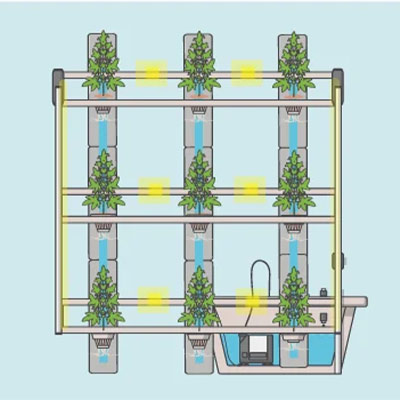
Here’s a visual example of how drip irrigation functions in vertical cannabis cultivation systems.
4. Climate & Airflow Management
Climate control is one of the most challenging aspects of vertical cannabis farming. Hot air rises, making the upper levels more difficult to cool. You will need:
- a powerful exhaust system,
- fresh air intake (active or passive),
- circulation fans for each layer,
- ideally a climate controller to balance temperature & humidity.
Air should move from intake → through all tiers → out the exhaust. This prevents hotspots and maintains stable conditions across your vertical grow setup.
Best Practices for Multi-Layer Cannabis Growing
A multi-layer cannabis grow system is less forgiving than a classic single-layer grow. With the following best practices, you can reduce risk and make the most of your cannabis vertical cultivation.
1. Choosing the Right Strains for Vertical Cannabis Farming
The basic rule is simple: the more compact the genetics, the better they fit into a vertical cannabis farming setup. Very tall, heavily stretching sativas tend to grow into the next tier and cause problems. Ideal are:
- compact indica-dominant strains,
- hybrids with moderate, controllable stretch,
- autoflower strains with predictable plant height.
Equally important is yield in relation to height. You want a strain that stays relatively short but still produces well — perfect for a cannabis vertical grow system that aims to maximize grow space and production.
Recommended Compact Strains for Vertical Setups
Several strains from the Linda Seeds range are particularly well suited for indoor cannabis vertical racks, as they stay compact, respond well to training, and deliver strong yields. Here’s an overview:
| Strain | Genetics / Type | Characteristics for Vertical Systems | Link |
|---|---|---|---|
| Afghan Kush Ryder (World of Seeds) | Autoflower, Indica | Extremely compact structure with heavy buds, ideal for lower tiers when you need robust, stress-resistant plants in a dense cannabis vertical grow system. | Afghan Kush Ryder |
| Auto Bubba's Gift (00 Seeds Bank) | Autoflower, Hybrid | Vigorous but well-controllable structure, resinous flowers; a strong choice for mid-level tiers when you want a balance of density, aroma, and stability. | Auto Bubba's Gift |
| Gnomo (Kannabia Seeds) | Autoflower, Indica | Very low, bushy plants, ideal for tight vertical racks for cannabis where each tier has limited height. | Gnomo |
| Speed Auto (Sweet Seeds) | Autoflower, Hybrid | Very fast from seed to harvest with solid yields at compact size — great if you plan multiple cycles per year in a hydroponic vertical cannabis or soil-based setup. | Speed Auto |
| Cookies Kush (Barney's Farm) | Feminized, Indica | Dense, compact plants with high yield potential; ideal for upper tiers with strong LED grow lights vertical setups and plenty of light intensity. | Cookies Kush |
| Killer Kush F1 Fast Version (Sweet Seeds) | Feminized, Indica-dominant | Fast flowering strain with controllable stretch — perfect when you need predictable height in a multi-layer cannabis grow system with tight vertical spacing. | Killer Kush F1 Fast Version |
| Master Kush (White Label Seeds) | Feminized, Indica | A classic compact indica with a solid, stable structure — excellent for middle tiers in indoor cannabis vertical racks. | Master Kush |
Here you can see how stunning this Auto Bubba’s Gift looks during flowering in a cylindrical vertical grow system. That’s why this strain is highly recommended for this type of cultivation.
2. Managing Light Intensity and Distance
In a vertical grow setup, the distance between LEDs and plant tops is often smaller than in a traditional single-layer tent. Pay attention to:
- using dimmable drivers to fine-tune intensity,
- adapting light levels per tier,
- checking plants frequently for signs of stress, bleaching, or light burn.
Lower levels can often run at slightly lower intensity, while upper tiers — where heat tends to accumulate — require particularly careful adjustment. Start with conservative light levels and increase gradually.
3. Nutrient Management in Vertical Systems
Whether you use soil, coco, or a hydroponic vertical cannabis setup, nutrient management is especially important in vertical cannabis farming, because mistakes can affect multiple tiers at once. Best practices:
- use a nutrient line with clear, easy-to-follow dosing guidelines,
- monitor EC and pH regularly, especially in recirculating systems,
- document your adjustments so you can quickly identify and correct issues.
4. Preventing Mold and Pests in Dense Vertical Grows
The denser the cannabis vertical cultivation layout, the higher the risk of mold and pests. Especially critical:
- high humidity during lights-off periods,
- stagnant air around dense buds or corners,
- hard-to-reach spots that rarely get inspected.
Countermeasures:
- provide sufficient air circulation on every level,
- thin out foliage strategically to improve airflow,
- inspect leaves and buds regularly with a handheld loupe or macro lens,
- use beneficial insects preventively early in the cycle if pest pressure is expected.
Challenges & Pitfalls in Vertical Cannabis Growing
A cannabis vertical grow system comes with clear advantages — but also specific challenges. For homegrowers, it’s crucial to evaluate these realistically before committing to a full vertical cannabis farming layout.
1. Higher Initial Investment
A multi-layer cannabis grow system requires more gear than a simple single-level tent. You’ll typically need:
- stable shelving or professional indoor cannabis vertical racks,
- multiple small LED panels instead of one large fixture,
- additional air circulation fans for each tier,
- a more sophisticated watering setup.
The initial cost is usually higher than a classic beginner grow. But over time, the increased efficiency and ability to maximize grow space can easily compensate for this — especially if you grow regularly or want to achieve indoor yield optimization.
2. Technical Complexity & Planning Requirements
Compared to a simple grow tent with one light, a vertical grow setup requires more detailed planning:
- Electrical circuits need to be safely distributed.
- Cable management must be clean (no cable bundles near water lines).
- The irrigation system must be leak-proof and reliable.
- Climate and airflow must work consistently across multiple tiers.
All of this is absolutely achievable — but you should give yourself enough time to understand your system before running a full grow cycle in a cannabis vertical cultivation layout.
3. Safety Considerations for Homegrowers
Safety becomes even more important in a vertical cannabis farming system:
- Use circuit breakers (RCD/GFCI) and properly rated cables.
- Keep all electrical connections clearly separated from water or nutrient lines.
- Anchor shelves or racks to the wall to prevent tipping — especially in apartments.
- Ensure access to all levels for emergency intervention.
In densely populated regions or smaller apartments, ensuring your vertical grow setup is safe and stable protects not only your plants but also your home and the people around you.
Who Should Consider Vertical Cannabis Farming?
A cannabis vertical grow system is not automatically the best option for everyone. It’s worth taking an honest look at your space, skills, and goals.
1. Homegrowers With Limited Floor Space
If you:
- only have a small room, closet, or storage area available,
- want to harvest regularly without expanding your footprint,
- and are willing to invest some time into planning and setup,
…then growing cannabis indoors vertical farming may be the ideal solution. Especially if you have good ceiling height (e.g., 2.4 m or more), you can turn unused vertical volume into productive grow area.
2. Semi-Professional Growers & Highly Ambitious Hobbyists
If you already have multiple successful grows under your belt, understand EC/pH management, and want to push your efficiency further, a vertical cannabis farming method can take your production to the next level:
- higher yields per cycle,
- more professional workflows,
- transferring commercial techniques into a homegrow environment.
In some legal contexts, a homegrower can build a compact but extremely efficient system using indoor cannabis vertical racks, LED grow lights vertical setups, and precise climate control.
3. Not Ideal for Complete Beginners
If you are just starting out, a vertical grow setup is usually *not* the best first step. You must manage many variables at once — lighting, airflow, irrigation, height control, and nutrient balancing.
Beginners are usually better off starting with:
- a single-layer tent with one LED,
- simple soil or coco grows,
- learning the fundamentals of watering, nutrition, and climate.
After gaining confidence, stepping up to a multi-layer cannabis grow system becomes much easier and much more rewarding.
HowTo – Step-by-Step Guide to Setting Up a Vertical Cannabis Grow
If you’ve decided to implement a vertical cannabis farming system, this step-by-step guide will help you build it successfully.
Step 1: Analyze Your Space & Height
Measure the exact width, depth, and height of your room or grow tent. Determine how many tiers can realistically fit without having the plants or LED panels too close together. Also consider space for air intake, exhaust, and access to each tier.
Step 2: Plan the Shelving or Rack System
Choose a stable heavy-duty shelf or specialized vertical racks for cannabis. Set each tier height so there is enough room for root containers, plant height, and LED clearance. Anchor racks to the wall for safety.
Step 3: Configure the LED Setup
Install dedicated LED grow lights vertical panels or bars for each tier. Use dimmable drivers to adjust intensity per layer. Ensure all cables are routed safely and protected from moisture.
Step 4: Set Up Irrigation & Nutrients
Choose your medium — soil, coco, or a hydroponic vertical cannabis method. Create separate feed lines and drainage for each tier to prevent dripping onto lower levels. Have your nutrient solution ready and monitor EC/pH consistently.
Step 5: Optimize Climate & Airflow
Install exhaust, intake, and oscillating fans for each tier. Test the environment without plants first and measure temperature and humidity at every level. Adjust fan positions until all tiers stay within similar ranges. This is key for grow room optimization.
Step 6: Choose Compact Strains & Place Plants Strategically
Select compact, easily managed genetics suitable for vertical cannabis farming. Place stronger, light-hungry strains on the upper tiers and more sensitive plants on the lower tiers where intensity is lower. This strategic placement helps maximize grow space and ensures balanced development.
Step 7: Test Run & Fine-Tuning
Start your first cycle in your vertical grow setup with conservative plant numbers and moderate light levels. Document any adjustments in lighting, airflow, nutrients, or irrigation. Use this data to continually refine your cannabis vertical cultivation system with each run.
Conclusion: Is Vertical Cannabis Farming Worth It?
Vertical cannabis farming is more than a trend — it’s one of the most effective ways for homegrowers with limited floor space to increase production. A well-designed cannabis vertical grow system can dramatically boost your usable canopy area and allow you to produce more cannabis without needing a larger room.
Key takeaways:
- Main benefits: better spatial efficiency, higher output per square foot, excellent synergy with LED grow lights vertical.
- Main requirements: careful planning, strong environmental control, and a safe irrigation and electrical layout.
- Ideal for: ambitious homegrowers and semi-professional cultivators seeking indoor yield optimization.
Whether or not a multi-layer cannabis grow system is right for you depends on your ceiling height, budget, and skill level. If you’re prepared to invest time in planning and precision, growing cannabis indoors vertical farming can take your production to a significantly higher level.
Linda Seeds offers a wide catalog of compact strains, nutrients, and equipment ideal for vertical growing — from autoflowering varieties to photoperiod indica-dominant strains that thrive in indoor cannabis vertical racks.
Vertical cultivation is more complex and less forgiving than a traditional single-layer grow. But if you enjoy technical optimization and want to maximize grow space without expanding your footprint, experimenting with a vertical grow setup can provide substantial long-term benefits.
FAQ – Frequently Asked Questions About Vertical Cannabis Farming
What is vertical cannabis farming?
Vertical cannabis farming means using not only your floor area but also the height of your room by stacking multiple grow tiers. Instead of one canopy under one light, you grow on shelves or racks across two or more layers. This method increases total canopy area without expanding your room footprint.
What are the advantages of a cannabis vertical grow system?
A cannabis vertical grow system improves efficiency by multiplying usable space, enabling higher yields per square foot. LED technology reduces heat and makes multi-layer setups feasible. Additionally, the structured design often leads to better overall grow room optimization.
Is vertical cannabis cultivation suitable for homegrowers?
Yes — if you have limited floor space but sufficient ceiling height, and you’re willing to plan carefully. For complete beginners, a single-layer grow is usually easier, but intermediate and advanced growers benefit greatly from vertical cannabis farming.
Which strains are best for multi-layer systems?
Compact indica-dominant or balanced hybrids perform best in a multi-layer cannabis grow system. Autoflowering cultivars also work well because of their predictable height and structure.
What equipment do I need for a vertical grow setup?
You’ll need sturdy racks, multiple LED grow lights vertical fixtures, a well-planned irrigation system, strong airflow management, and basic measurement tools for pH/EC. A safe and organized electrical layout is essential, especially when stacking tiers.