BackAre cannabis cuttings legal in Germany? What the law really allows
28.01.2026

Are cannabis cuttings legal in Germany?
Short answer:
- The free sale of cannabis cuttings in Germany is restricted when cuttings are rooted or planted in substrate, as they may legally qualify as cannabis.
- Cannabis seeds are legal in Germany and can be purchased freely for home cultivation within the permitted limits.
- To minimize legal risk, home growers in Germany generally rely on seeds rather than cuttings.
This makes one thing clear: The legal status of cannabis cuttings in Germany depends on their condition. While non-rooted cuttings may be treated as propagation material, rooted or planted cannabis cuttings are interpreted differently under German law and can be classified as cannabis.
When Germany introduced its new cannabis law on April 1st, 2024, international media reacted immediately. Headlines across Europe and North America announced that Germany had “legalized cannabis,” framing the reform as a historic shift in European drug policy.
For many observers in the EU and the United States, the move appeared to place Germany alongside Canada and U.S. states such as California, Colorado, or New York. Expectations were high: regulated markets, legal cultivation, and a gradual normalization of cannabis across Europe.
More than a year later, it has become clear that Germany chose a very different path. While cannabis is now partially legal, the German model is highly regulated, restrictive, and legally technical. Few issues illustrate this better than the treatment of cannabis cuttings in Germany.
A legalization that felt bigger than it actually is
Germany’s reform was undeniably significant. For the first time, adults are allowed to:
- possess limited amounts of cannabis
- consume cannabis privately
- grow up to three plants per adult for personal use
In a European context, this represents progress. Internationally, however—especially from a U.S. perspective—the reform has often been misunderstood.
Germany did not legalize commercial cannabis sales, dispensaries, licensed for-profit cultivation, or a national cannabis market. Instead, the framework focuses on controlled decriminalization rather than full legalization in the North American sense.
Why Germany rejected the US and Canadian models
To understand Germany’s approach, it is important to look at what lawmakers deliberately avoided. In Canada and many U.S. states, cannabis is treated as a regulated consumer product, commercial markets exist, and cuttings or clones are legally traded.
Germany explicitly rejected this framework. Lawmakers expressed concerns about rapid market expansion, corporate influence, loss of state control, and political backlash. As a result, the German Cannabis Act (KCanG) is built on restriction by design.

Cannabis legalization in Germany is sparking controversy. The new “freedom” is less free than hoped.
The German cannabis model in simple terms
Germany’s cannabis framework rests on three core principles:
- Personal use is allowed, but limited
- Commercial trade remains prohibited
- Reproduction and distribution are tightly controlled
This approach applies not only to cannabis flowers, but also to plants, cuttings, and propagation material.
Cannabis cuttings in Germany: the issue nobody expected
For growers in the United States or Canada, cannabis cuttings are a routine part of cultivation. Clones are widely sold and used in both home and commercial settings.
In Germany, many assumed the same logic would apply. After all, cuttings contain no THC, are not consumable, and appear to be simple plant material. This assumption, however, turned out to be incorrect.
The Cologne administrative court ruling on cannabis cuttings
In November 2025, Germany’s Administrative Court of Cologne (Verwaltungsgericht Köln) ruled on a case that would define the legal status of cannabis cuttings in Germany.
A retailer was selling cannabis cuttings that were already rooted and planted in substrate, both online and in a physical store. The argument was straightforward: the plants were not flowering and therefore should not be treated as cannabis.
The court disagreed.
The court’s reasoning
The ruling stated that a rooted and planted cannabis cutting qualifies as cannabis regardless of its size, stage of growth, or THC content. As a result:
- the free sale of cannabis cuttings is prohibited
- there is no open legal market for cuttings in Germany
- commercial distribution may lead to fines or enforcement measures
This decision has become a key reference point for interpreting German cannabis law.
Why Germany treats cuttings as cannabis
From a legal perspective, Germany defines cannabis broadly. Once a cutting has formed roots, been planted in substrate, and begun autonomous growth, it is no longer treated as simple propagation material but as a living cannabis plant.
This interpretation serves a clear purpose: preventing uncontrolled reproduction and distribution. Cuttings allow fast, uniform, and scalable cultivation, which conflicts with Germany’s goal of strict regulatory control.
Seeds vs. cuttings: a crucial legal distinction
One of the most important aspects of German cannabis law is the distinction between seeds and cuttings.
Cannabis seeds in Germany contain no THC, are not legally classified as cannabis, and can be freely purchased for home cultivation within legal limits.
Cannabis cuttings in Germany, by contrast, qualify as cannabis once rooted and cannot be freely sold or purchased outside tightly regulated structures.
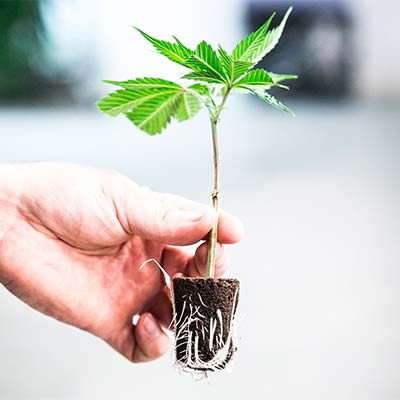
In Germany, a cutting is considered illegal if sold. Trading it is prohibited as soon as it has rooted.
How German growers adapt to these rules
Because cuttings carry legal risk, most German home growers rely exclusively on seeds. Popular options include:
- autoflowering cannabis seeds, which flower automatically
- feminized cannabis seeds, which produce only female plants
These seed types align well with the German legal framework and reduce legal uncertainty compared to the use of cannabis cuttings.
Why the cuttings issue matters internationally
The ruling on cannabis cuttings highlights an important reality of German cannabis legalization: seemingly technical details can carry serious legal consequences.
For EU and US audiences alike, Germany’s experience shows that legalization does not function identically across jurisdictions.
Germany compared to other European countries
The following table highlights how Germany’s cannabis rules differ from selected European countries, particularly regarding home growing, seeds, and cannabis cuttings.
| Country | Home grow | Cannabis seeds | Cannabis cuttings | Commercial sales |
|---|---|---|---|---|
| Germany | Yes (up to 3 plants) | Legal | Restricted | No |
| Spain | Tolerated (private) | Legal | Grey area | No |
| France | No | Legal | Illegal | No |
| Netherlands | Limited | Legal | Restricted | Coffee shops only |
| Portugal | Decriminalized | Legal | Restricted | No |
Conclusion: progress with constraints
Germany’s cannabis reform marks a historic moment in European drug policy. However, it is not a free-market model. The legal treatment of cannabis cuttings demonstrates how carefully Germany is balancing reform with control.

Legalized cannabis isn’t really what many imagined. The new “freedom” comes with many limits.
Note: This article does not constitute legal advice. It reflects the current legal framework and its general interpretation.